
You’re doing everything right—working, studying, staying informed—but life
still feels rigged. Wages stagnate. Rents soar. Public services crumble.
Politics feel like theatre. It’s tempting to think the system is broken. But
what if it’s not?
What if this is exactly what the system was rewired to do?
This essay reframes what looks like failure as structure—how inequality,
instability, and institutional decay aren’t accidents but outcomes. And how
that system, built around asset appreciation rather than public value,
continues to perform well—for those it was redesigned to serve.
Why things feel like they’re falling apart
We’re told to work hard, stay in school, buy in. But that story—where effort
leads to security—doesn’t hold anymore. For many, wages aren’t rising, housing
is unaffordable, and the future feels narrower than the past. It’s not just a
rough patch. It’s systemic.
The deeper engine behind the chaos
A few years ago, Alex Hochuli described what he called the
_Brazilianization_¹ of the West: elite impunity, decaying infrastructure, and
widespread informal work—symptoms long associated with the postcolonial Global
South, now appearing in Europe and North America.
But these aren’t cultural imports. They’re structural exports. We’re not
becoming like Brazil. We’re all converging on the same system logic: one that
rewards asset ownership, punishes labor, and treats public goods as private
opportunities.
Why owning matters more than earning
In today’s economy, value doesn’t come from what you do—it comes from what you
own. A home. A pension fund. A platform. If you rely on wages, you’re exposed.
If you own appreciating assets, you’re insulated. Productivity no longer
raises incomes. Political promises feel thin. The system rewards holding, not
contributing.
Cities aren’t neglected. They’re reprogrammed.
When capital drives planning, public interest comes second. Cities now optimize
for return, not need. Housing becomes an asset class. Transit must break even
or be cut. Infrastructure decays—not because of dysfunction, but because it
doesn’t produce short-term profit.
Why doing all the right things isn’t enough
The new economic divide isn’t between industries or job types. It’s between
those who can accumulate assets and those who can’t. A postgraduate with no
capital faces the same structural instability as a gig worker. This isn’t
meritocracy failing. It’s a meritocracy without a payout.
The state isn’t asleep. It’s serving something else.
States can move fast—when the markets care. Central banks stabilize capital in
hours. Infrastructure takes years. In Jackson, Mississippi, residents had no
safe water for weeks, while investor confidence went undisturbed². It’s not
incompetence. It’s alignment. Mariana Mazzucato calls this the
“de-risking state”³: strong for capital, weak for citizens.
Why people check out instead of speak up
Political disengagement isn’t laziness. It’s feedback. When people realize
voting changes little, they adapt. Hustling, ghosting, optimizing for survival
aren’t character flaws—they’re rational responses. Michel Foucault’s idea of
the _entrepreneur of the self_⁴ now describes most of us: performative,
responsibilized, and on our own.
The gig economy isn’t new. It’s just digitized.
The informal labor conditions long familiar in the Global South—no contracts,
no protections, inconsistent hours—now exist in app form. Uber, Deliveroo,
Upwork: precarity as a service. We didn’t import Brazil’s labor model. We
automated it.
Who’s really in charge?
Asset-first economies shift power from voters to markets. Bondholders
discipline budgets. Ratings agencies shape policy. Capital mobility undermines
sovereignty. This is sovereignty by subscription: you govern, but only if
investors approve. Stay solvent—or surrender control.
The future isn’t failing. It’s vanishing.
Zygmunt Bauman’s “liquid modernity”⁵ has become liquid legitimacy—a world
where institutions don’t collapse, they just dissolve. Local councils go
bankrupt while paying investors. Public services erode without drama. David
Harvey called this _accumulation by dispossession_⁶—extracting public value and
turning it private.
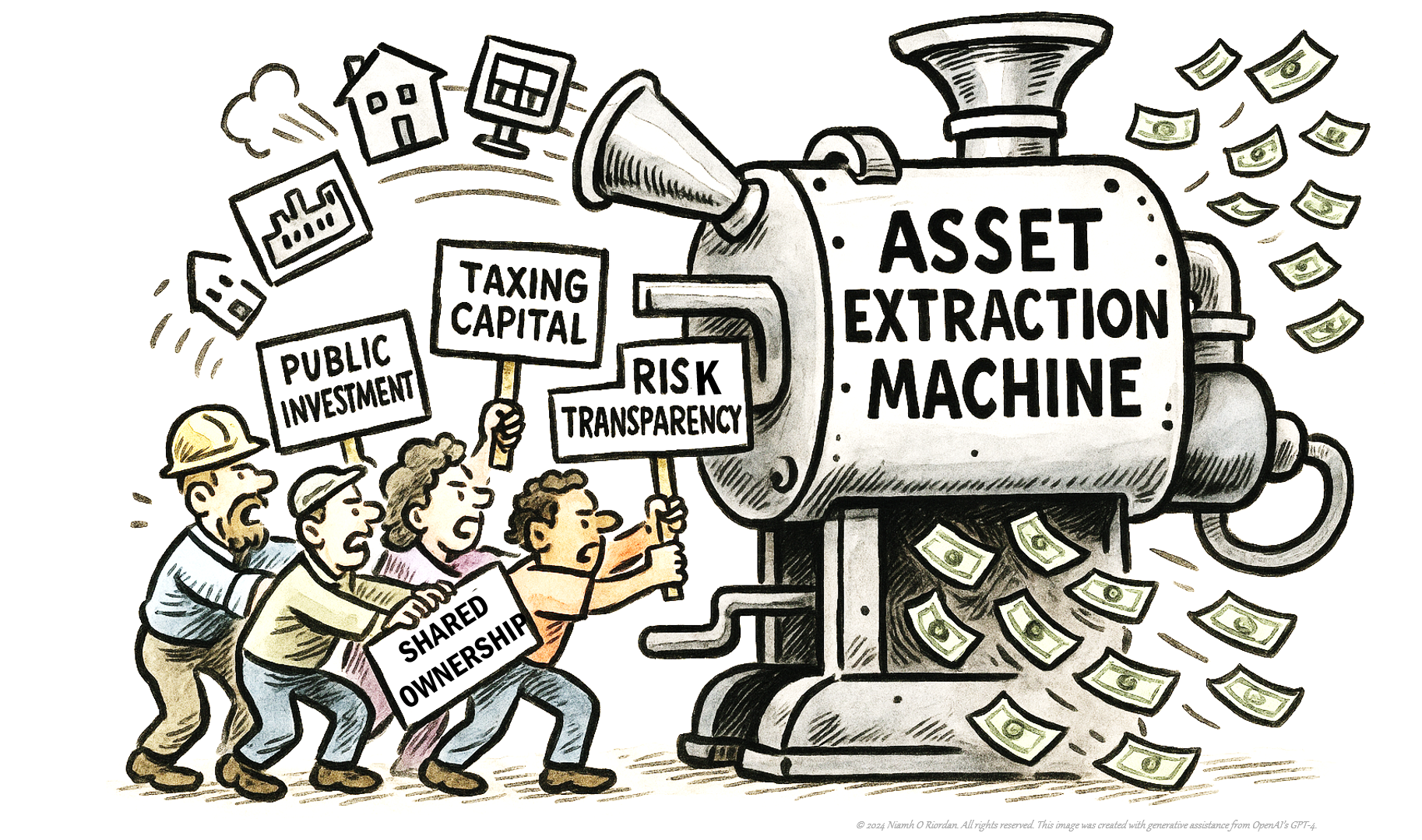
If this is the system—how do we change it?
First, revalue what counts. Thomas Piketty⁷ shows how inequality grows when
capital gains outpace wages. Taxing wealth like work isn’t radical—it’s
repair. So is treating housing as shelter, not speculation. So is defining data
as infrastructure, not property.
Second, change how we own. Shared wealth funds, municipal broadband, platform
co-ops—these models spread value instead of hoarding it. Mariana Mazzucato’s
_mission economy_³ says public investment shouldn’t just clean up after
markets. It should lead.
Third, make opacity expensive. Complexity fuels financial power. Transparency
shifts it. Demand systems that are legible to the public—not just analysts.
Finally, change the story. The old one said markets were rational, ownership
was merit, and wealth would trickle down. It hasn’t. We need a new story. One
where value is shared. Risk is mutual. And the future belongs to more than a
portfolio.
Curious about some of the terms used here? See the glossary below for a
plain-language guide to the system you’re already living in.
The Asset Economy: A Glossary of Terms You’ve Probably Lived Through
Asset Economy
The foundational concept of this piece: a system where economic power comes from what is owned, not what is done. As stocks, housing, data, and infrastructure become assets, labour becomes marginal. What looks like stagnation is often redistribution—upward.
Financialization
When everyday life becomes an investment opportunity. From housing to healthcare to higher education, value shifts from use to yield. Prices rise, access narrows, and complexity multiplies. It’s a system designed for trading, not living.
Entrepreneur of the Self
Borrowed from Michel Foucault. Describes how individuals are responsibilised to manage themselves like micro-enterprises. The line between person and portfolio dissolves. Selfhood becomes performance, and precarity becomes a brand.
Platformed Informality
A term used here to describe the digitised replication of informal labour conditions. The same low-rights, high-risk dynamics long associated with informal economies—now scaled and automated by platforms. No contracts, no protections, just “flexibility.”
Sovereignty by Subscription
Coined in this piece to describe the condition where national autonomy is effectively leased back from capital markets. Governments remain in charge on paper, but policy direction is shaped by bondholders, rating agencies, and investment flows.
Liquid Legitimacy
An adaptation of Zygmunt Bauman’s concept of “liquid modernity.” In this context, institutions do not collapse in scandal—they dissolve in irrelevance. Nothing settles. Nothing transforms. The erosion of authority comes not through crisis, but through fatigue.
Accumulation by Dispossession
A concept developed by David Harvey. Refers to how capital expands by enclosing and extracting from the commons. Public goods become private assets. Shared infrastructure is dismantled and sold back at a profit.
Mission Economy
Developed by Mariana Mazzucato. Describes a state-led model of innovation and investment, where public goals—not just market failures—set direction. Value creation is coordinated, long-term, and collective.
Public Investment
Used here to signal more than fiscal stimulus. True public investment means funding what markets avoid or degrade: universal care, climate adaptation, digital access. It’s not just about spending. It’s about designing for resilience.
References & Sources
- Piketty, Thomas. Capital in the Twenty-First Century (2014).
- Hochuli, Alex. “The Brazilianization of the World.” American Affairs, Volume V, Number 2 (Summer 2021).
- Green, Emma. “Why Jackson’s Water Crisis Is a Warning for America.” The New Yorker, September 2022.
- Mazzucato, Mariana. The Entrepreneurial State and Mission Economy: A Moonshot Guide to Changing Capitalism (2021).
- Foucault, Michel. The Birth of Biopolitics: Lectures at the Collège de France, 1978–1979 (2008).
- Bauman, Zygmunt. Liquid Modernity (2000).
- Harvey, David. The New Imperialism (2003).
© 2024 Niamh O Riordan. All rights reserved. This article was developed with generative assistance from OpenAI’s GPT-4. All ideas, perspectives, and final editorial decisions are the author’s own.
 Doing All The Things